
 EN

Why Black Wrapping Tissue Paper Is Widely Used for Premium Cosmetics
For premium cosmetics, the first reveal often begins before a customer sees the bottle, palette, or jar. Black wrapping tissue paper creates a quiet visual frame around the product, helping a packed order feel considered rather than merely protected. It is not automatically the right choice for every line, though. The useful question is how black tissue supports the brand presentation and the packing routine together.
From a gift-wrap and retail merchandising perspective, a tissue choice should be judged by the unboxing impression and by how it fits the packing station. A color that looks balanced on its own can read very differently beside a pale carton, a metallic cap, or a vividly printed insert. That is why sample review should happen with the actual cosmetic components, not just against a screen swatch.
Black wrapping tissue paper creates a controlled premium backdrop
The appeal of black wrapping tissue paper is primarily visual. For many premium cosmetic teams, black wrapping tissue paper is the packaging layer that sets the tone before the product is touched. Its dark field can make light-colored cartons, foil details, embossed marks, and pale ribbons easier to notice at the moment of opening. For a cosmetic brand with a restrained or high-contrast identity, that backdrop can make the package feel more deliberate without adding another printed component.
At first this may look like a color decision; more accurately, it is a color-and-workflow decision. Black tissue is often chosen because it reduces visual clutter inside a box, but the final effect depends on the box interior, product finish, label colors, and how the tissue is folded. A neat reveal can be more valuable than a dramatic shade that fights with the product itself.
Commercial listings illustrate that black tissue is commonly sold in both sheets and rolls for retail and eCommerce wrapping. One supplier, for example, positions a 20 x 30 inch (50.8 x 76.2 cm) black tissue format for retail and eCommerce uses, including cosmetics. That is an example of an available format, not a universal requirement: the right sheet size should be confirmed around the actual carton dimensions and desired fold.
Black wrapping tissue paper supports a more intentional unboxing sequence
Cosmetics are frequently bought for personal rituals, gifting, or replenishment, so the opening sequence matters. In that sequence, black wrapping tissue paper can turn a simple inner layer into a recognizable presentation cue. Black wrapping tissue paper can separate the outer shipping box from the branded product layer, giving the recipient a small pause before the item is revealed. This is especially useful when a brand wants the inner package to look composed even after transit.
The first fold may determine whether the presentation feels deliberate or improvised. A simple test is to prepare a representative order, place the product and any card or sample in their planned positions, then make the same fold a packer will make repeatedly. If the tissue opens too quickly, hides a key message, or makes inserts shift, the attractive color alone has not solved the pack-out problem.
Black tissue paper can also make a small product feel more visually anchored inside a larger gift box. It should not be treated as a substitute for protective components, however. Tissue may contribute to separation and presentation, while cushioning, dividers, seals, or other protective elements must be selected for the actual product and shipping conditions.
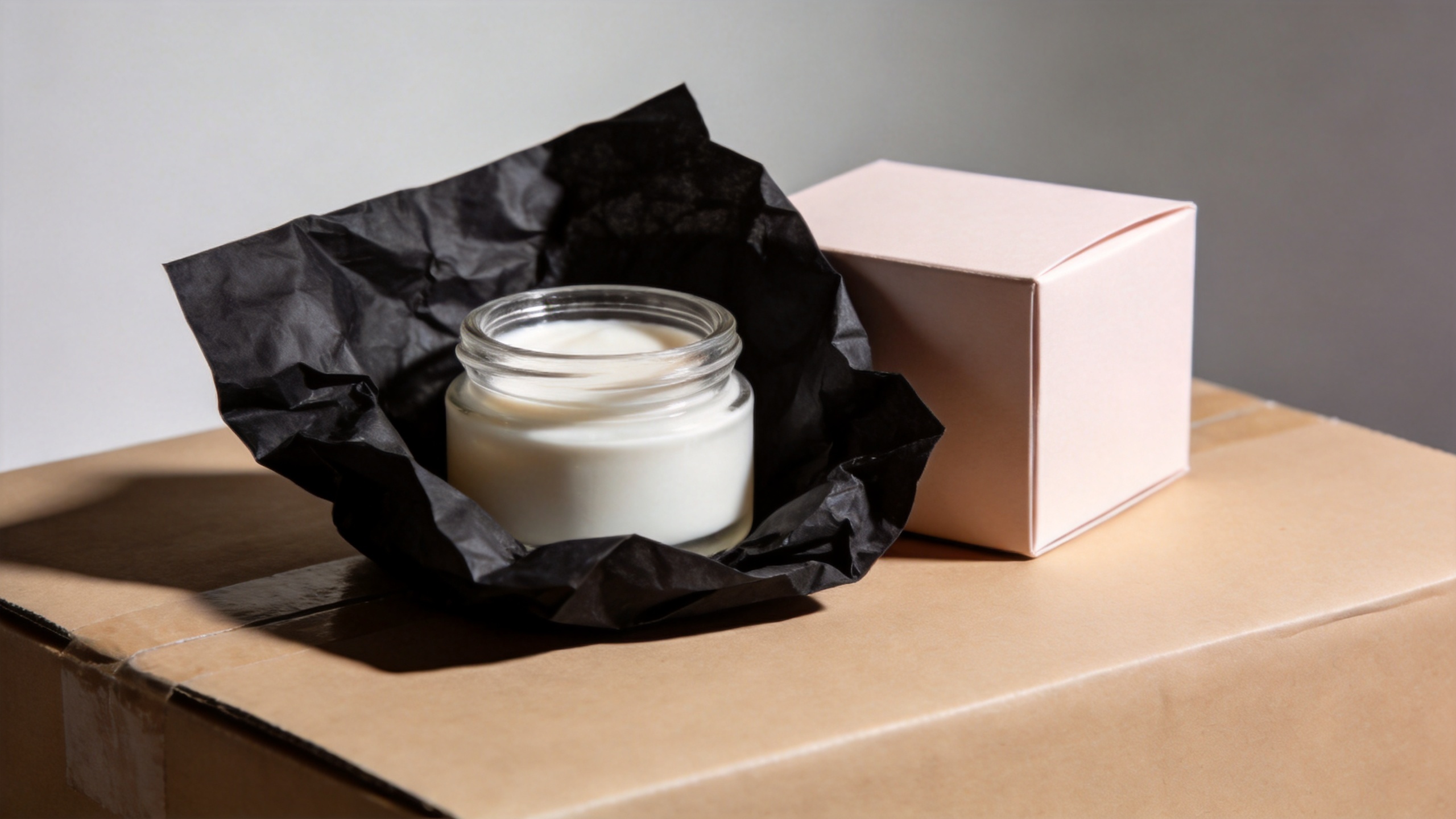
Why black wrapping tissue paper suits many premium cosmetic identities
Premium cosmetics often rely on signals such as restraint, contrast, tactility, and consistency across touchpoints. When approved against the product, black wrapping tissue paper gives those signals a quiet, repeatable setting. Black wrapping tissue paper can complement those signals when its shade and finish are reviewed beside the finished pack. It can be a sensible fit for minimalist black-and-white systems, jewel-tone palettes, metallic accents, and collections that use a dark visual language.
- Contrast: Light cartons, silver details, or pale labels may be easier to read against a dark surrounding layer.
- Focus: A single deep color can keep the box interior from competing with the product reveal.
- Flexibility: The same black tissue may work across several collections when the core brand system is stable.
- Gift readiness: A carefully folded interior can make a direct-to-consumer order feel closer to a prepared gift.
These are presentation benefits, not guarantees. For a presentation-led package, assess visual impact alongside operational factors: Does the tissue leave the intended surface looking clean? Is the chosen shade approved against the actual box? Will the packing team use sheets, a continuous roll, or both? Those questions keep a visual preference from becoming an untested assumption.
Choose black wrapping tissue paper format around the packing table
That is the appearance side. The next question is how black wrapping tissue paper reaches the packing table. Pre-cut sheets can help a team repeat a specific fold and create a consistent reveal. Roll stock can be useful where product sizes vary or the tissue must be cut to suit different carton dimensions. Neither format is automatically better; the appropriate choice depends on the order mix and the desired level of repeatability.
At a packing table, small handling interruptions can matter more than a feature list suggests. Watch where the packer reaches, tears, folds, and replenishes material. If a cosmetic range includes delicate compacts, tall bottles, and small gift sets, test representative shapes rather than approving tissue with only one hero product. A tissue choice that looks appropriate for one size may behave differently in a mixed-order station.
Basis weight, softness, opacity, sheet dimensions, and converting details should likewise be confirmed with the supplier. Retail listings show considerable variation; for instance, one craft-market listing describes black tissue in 20 x 20 inch sheets at 18 gsm. That specification is a useful reminder to ask precise questions, not a target to copy. The required feel and coverage depend on the product, fold, and secondary package.
Use black wrapping tissue paper without overpromising
Black tissue paper and black wrapping tissue paper should be sampled with the real cosmetics and packing components before it becomes a standard. This is important when products have light finishes, labels, or surfaces where visual transfer, scuffing, or dust would be a concern. Do not assume colorfastness, protective performance, or compatibility from appearance alone; request relevant material information and run a pack-out trial under the intended handling conditions.
A useful approval review can cover the following points:
- Place the tissue beside the finished carton, primary pack, ribbon, and printed insert.
- Fold a production-like sample around the largest and smallest products in the range.
- Check whether the product remains easy to locate and remove without disturbing other components.
- Confirm the paper format, color reference, quantity context, and any printing requirements in the inquiry.
- Record what the sample established and what still needs supplier confirmation.
Black wrapping tissue paper is widely used because it can provide a clean, focused stage for a premium cosmetic reveal. A stronger result comes from treating it as part of the entire pack-out sequence: choose it for the visual role it can play, then validate size, handling, material behavior, and product compatibility with samples. In short, let the brand lead the color choice, but let the real packaging workflow decide whether the choice is ready to scale.