
 EN

What Makes Black Tissue Paper for Packaging Ideal for Dark Colored Products?
Black tissue paper for packaging can give dark-colored products a deliberate, composed presentation while adding a light protective layer between an item and its box, bag, or other packed pieces. At first this may look like a color decision; more accurately, it is a color-and-workflow decision. A black watch box, charcoal garment, dark glass cosmetic bottle, or deep-toned gift often looks more unified when the surrounding tissue does not create a bright visual interruption. Whether that choice works in a real pack-out depends on the product finish, the handling steps, the tissue format, and a sample check before a bulk order.
From a packaging-paper technical advisor’s perspective, the starting point is not a generic claim that black tissue is universally suitable. It is matching the fiber feel, basis weight, and converting needs to the item being packed. For dark products, that approach helps a buyer decide when black tissue paper for packaging supports the intended look and when another material, color, or extra barrier may be the safer choice.
Why black creates a more continuous presentation around dark products
Dark merchandise already carries visual weight. A black tissue paper wrap can extend that color field from the product to the unboxing layer, so the product appears intentionally framed rather than dropped into a bright interior. This is useful for retail boxes, gift sets, fashion accessories, cosmetics, and event packaging.
The benefit is not limited to “luxury.” A dark tissue layer can also simplify presentation when several components have different dark finishes: for example, a matte carton, a satin ribbon, and a glossy bottle. Instead of asking the tissue to match every undertone exactly, the packing team can use black as a neutral dark backdrop. That reduces the number of visual clashes a customer sees at first glance.
Black tissue paper is especially helpful where a white or pale liner could show through gaps, folds, or open edges. Judge the color relationship under the lighting in which customers will see the pack, since black, charcoal, navy, and brown can read differently.
Black tissue paper for packaging adds separation without bulky cushioning
Color is the appearance side. The next question is how the material reaches the packing table. Tissue can be used as a light separator between surfaces, a wrap around a delicate item, or a layer inside a gift bag or rigid box. It is not a substitute for engineered protection when an item is fragile or heavy, but it can reduce direct surface-to-surface contact in a carefully designed pack-out.
For dark colored products, that separation can matter because scuffs, fingerprints, dust, and small abrasion marks may be easier to notice on certain finishes. A packing team can fold black tissue paper around the item, place it as a box liner, or use it between components, then add protection suited to the transport risk.
Rather than choosing a shade first, clarify whether the tissue is for lining, wrapping, or light void fill. Lining puts visual consistency first; wrapping needs workable folds and repeatable sheet dimensions. A black tissue paper roll may help a busy station cut to length, while pre-cut sheets may make folding more consistent. Confirm the format and dimensions with the supplier.
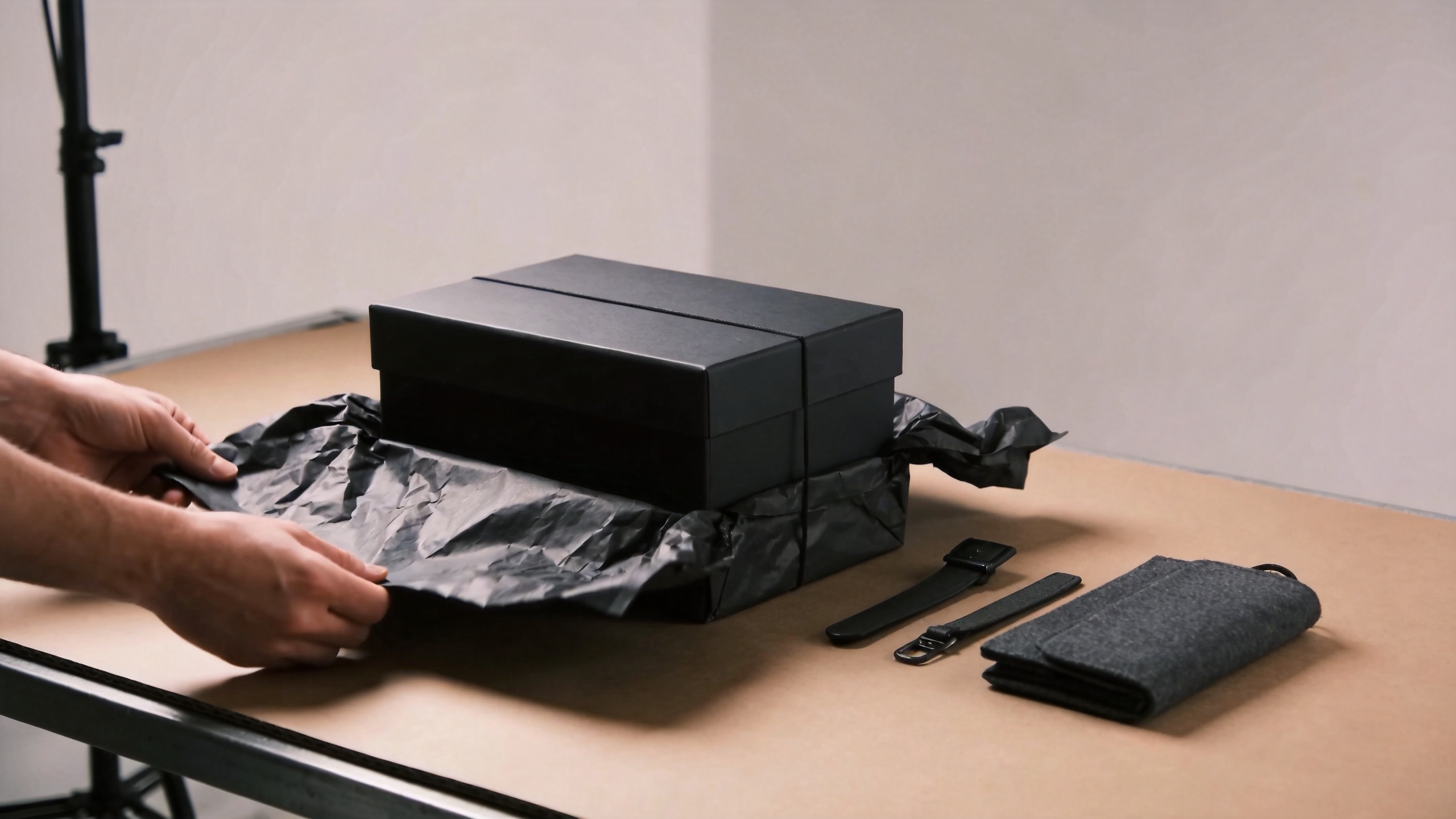
Dark-on-dark packaging can make small presentation issues less distracting
Dark tissue does not make flaws disappear, and it should not be used to hide product defects. It can, however, make a presentation feel calmer when the product, carton, and wrap share a dark palette. Minor overlaps in the tissue are less likely to look like a high-contrast design mistake than they would with a white liner around a black item.
This is useful when an order contains multiple dark accessories, a black garment with matching trim, or a dark cosmetics set. The tissue becomes part of the visual hierarchy: product first, packing detail second. It can also give a small item more presence inside a larger box.
That said, black is not automatically the right choice for every dark item. A very dark matte product may lose edge definition inside an all-black box. In that case, a controlled contrast—such as a dark gray tissue, a narrow branded band, or a light inner card—may make handling and presentation clearer. The practical question is not “Will black look premium?” but “Can the customer immediately understand what to lift, open, and keep?”
Check color transfer and surface compatibility before approving a run
For dark products, buyers sometimes focus only on whether the color coordinates. A more useful check is whether the tissue, product finish, ink, adhesive, coating, and packing process work together. Color or surface transfer is not something that can be assumed away based on tissue color alone. It can be influenced by moisture, pressure, friction, storage conditions, and contact time.
Ink-rub and abrasion checks are commonly used to evaluate transfer and surface durability on paper-related materials. That does not establish a result for a particular black tissue paper for packaging order. It does give a sensible reason to request representative samples and simulate the actual packing process. Wrap the real product or a finish-matched sample, apply the normal fold pressure, keep it in the planned box, and inspect it after the expected dwell time and handling.
- Test the tissue against the real product surface, not only against a generic black sample.
- Include printed cartons, labels, ribbons, and inserts that will touch the tissue.
- Check dry handling as well as the conditions relevant to your warehouse or shipping environment.
- Ask the supplier which material details, color process, sheet or roll format, and sample options can be confirmed for the order.
- Record the approved sample and packing sequence so production teams can repeat it consistently.
This is where a sample-led decision is stronger than a color-only decision. If the use case involves sensitive finishes, pale adjacent components, food-contact requirements, or regulated claims, obtain the relevant documentation and application-specific advice before production.
Choose the tissue format around the packing line, not only the product photo
Black tissue paper for packaging needs to work at the speed and scale of the operation. A boutique may prefer sheets that staff can fan, fold, and place with care. A higher-volume pack station may prioritize a roll or a consistently sized sheet that reduces trimming and variation. Neither format is universally better; the better option is the one that supports the required appearance without disrupting packing time or material control.
Ask practical questions early: What box or bag dimensions are in use? How many folds are needed? Does the item have corners that need a soft wrap? Will employees pack one product at a time or assemble kits? Is the tissue a visible outer wrap, a hidden liner, or both? The answers affect sheet size, cut accuracy, basis weight, and the amount of tissue used per order.
For brands that sell across several markets, a consistent black tissue presentation can help collections feel connected. Putian C&Q Paper Co., Ltd. describes its scope as packaging, decorative, and filling paper applications, with custom slit rolls and sheets for international supply. Confirm specifications, colors, and suitability against the current sample and order requirements.
A buyer checklist for black tissue paper around dark merchandise
- Define the role. Decide whether the tissue is a visible wrap, a box liner, a separator, or light fill.
- Review the visual hierarchy. Compare the tissue with the product, box interior, labels, and ribbons under expected lighting.
- Confirm usable dimensions. Choose sheets or rolls based on the actual folding pattern and packing-station workflow.
- Run a handling sample. Test contact, fold pressure, dwell time, and normal shipping or storage conditions.
- Document the approved pack-out. Keep the selected tissue, fold method, and associated components together in the production reference.
Final perspective
Black tissue paper for packaging is ideal for many dark colored products because it can create a continuous visual setting, provide a light separation layer, and support a neat, restrained unboxing experience. Its value comes from fit, not from color alone. When the tissue format matches the packing line and a representative sample confirms compatibility with the product and adjacent materials, black tissue paper can become a reliable part of a dark-toned packaging system.
Before placing a bulk order, move from color-only to workflow-first: specify the use case, review the real materials together, and confirm the sample conditions that matter to your customers. That process protects both the product presentation and the consistency of the people packing it.