
 EN

How gift wrapping paper sheet helps you standardize packaging sizes
For a packaging buyer, a gift wrapping paper sheet is more than a decorative surface. It is a repeatable input for a packing station. When the sheet size changes from order to order, staff must judge coverage, fold depth, tape position, and trim length each time. A defined sheet program replaces much of that judgment with a shared routine. That matters for retailers, gift-box assemblers, brand teams, and fulfillment partners that want presentation to look intentional while their process remains practical.
At Putian C&Q Paper Co., Ltd., the business context includes packaging, decorative, and filling paper for overseas markets, along with custom slit rolls and sheets. That makes format selection a useful procurement discussion: the right paper sheet is not simply the largest sheet available. It is the format that fits the package family, the chosen folding method, and the replenishment method used by the team.
Why a defined gift wrapping paper sheet format changes the workflow
A roll gives a packer freedom to cut a different length for every item. That can be helpful for irregular or seasonal packs, but it also moves measuring and cutting to the packing bench. A pre-cut gift wrapping paper sheet moves those decisions upstream. Each operator begins with the same width and length, which makes training, work instructions, and visual inspection easier to align.
Standardization does not mean every product receives the same wrap. It means the business deliberately limits the number of paper sheet formats. A small box, a medium gift set, and a larger presentation carton may each need a different format. The useful question is whether those three formats cover most daily orders without excessive trimming or awkward folds.
Paper manufacturing and converting already distinguish between raw and trimmed formats. For example, ISO paper references include larger raw formats that allow for finishing and trimming. A gift-wrap program can apply the same practical idea: define the finished usable size, then confirm that the conversion plan leaves enough material for folds while avoiding needless offcuts.
Start with package dimensions, not an attractive pattern
To specify a gift wrapping paper sheet, collect the outside length, width, and height of the packaged item or finished carton. Then note the folding style. A simple overlap wrap, an envelope fold, and a pleated end treatment consume different amounts of paper. Do not assume that a sheet which covers the top of a carton will also provide enough side coverage and a neat closure.
A practical sizing worksheet can include:
- the package dimensions after protective inserts and outer cartons are in place;
- the desired overlap at the main seam;
- the fold allowance for both ends;
- any label, sticker, ribbon, or band position that must remain visible;
- the acceptable trim allowance; and
- the intended orientation of the design, grain, or logo artwork.
Run a small sample set through the actual packing motion. Measure the paper remaining after the final fold, not only the sheet before wrapping. If one format repeatedly produces large offcuts, it may be too generous. If operators pull hard to make the seam meet, it may be too small. Sample observations are more useful than a nominal size chosen only from a supplier catalog.
Build a short size matrix for the paper sheet program
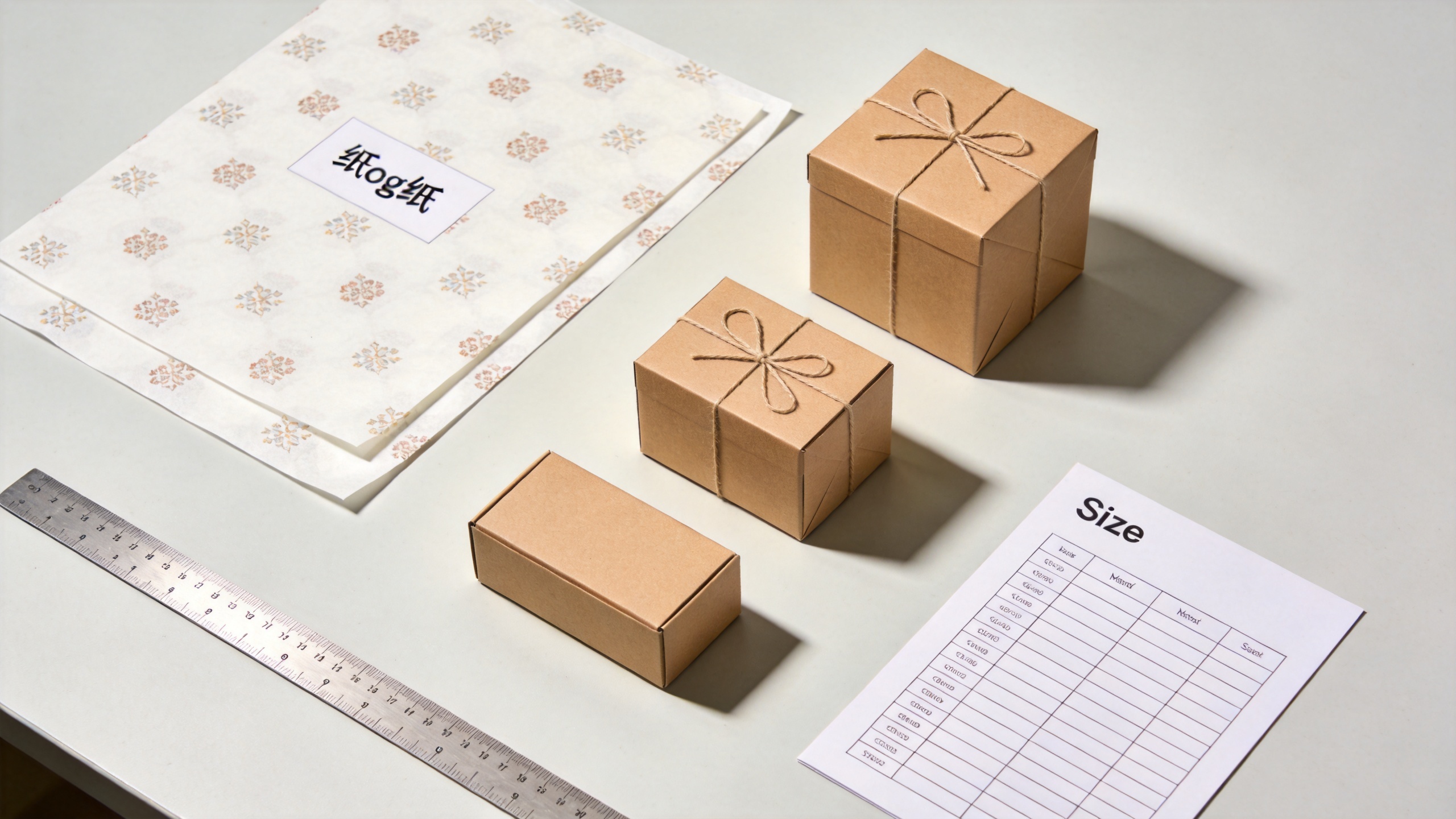
The goal is usually a short, understandable matrix rather than a long menu of near-duplicate sizes. Start by grouping products with similar carton footprints and heights. Select a provisional gift wrapping paper sheet size for each group, then test it on the smallest, median, and largest packages in that group.
| Package group | What to verify | Decision outcome |
|---|---|---|
| Small flat gifts | Corner folds and seam overlap | Confirm a compact sheet without excessive trim |
| Medium boxed sets | End-fold allowance and presentation face | Use one repeatable format where the variation is manageable |
| Tall or deep cartons | Side-wall coverage and closure position | Consider a separate format instead of forcing an undersized sheet |
Keep the matrix with the packing instructions. It should name the package group, the selected paper sheet, orientation, fold method, and revision date. This gives purchasing a clear item description and gives quality staff a stable point of comparison when a new shipment arrives.
Standardization improves purchasing conversations
Once the size matrix is stable, procurement can request quotations using complete descriptions rather than broad phrases such as “gift wrap.” State the finished sheet dimensions, paper type, color or artwork reference, pack count, tolerance expectations, and any packing requirement. If the design is directional, clarify which edge is the width and which is the length. These details reduce the chance that a paper sheet is technically the correct area but oriented incorrectly for the pack.
For custom work, discuss how the finished sheet relates to the supplier’s converting process. A format that nests efficiently within a parent sheet may support cleaner production planning, while a highly unusual size can create more trim management. That is a conversation to have before approving artwork, not after inventory is received. The decision should also account for storage: a format that fits racks, drawers, or packing-station dispensers is easier to issue consistently.
Use simple controls at receiving and packing
A standardized gift wrapping paper sheet program works when the format is checked at more than one point. At receiving, inspect a sample for dimension, count, print orientation, color consistency, and edge condition against the purchase specification. At the packing station, keep only the formats assigned to that workstation or clearly label each stack. A visible size code can be more useful than relying on a pattern name alone.
During a routine quality review, compare the finished package with an approved sample. Look at seam placement, corner symmetry, exposed carton edges, and the amount of paper removed during trimming. If a package design changes, repeat the sample wrap before changing the size matrix. This prevents an old paper sheet from quietly becoming the wrong format for a revised carton.
When sheets are the better choice—and when they are not
A gift wrapping paper sheet is a strong fit when the product range is stable, the wrap style is repeated often, and a polished presentation is part of the customer experience. Pre-cut sheets can also simplify kitting because each packer takes one known format per item. They may be less suitable when carton sizes vary widely or when a low-volume operation frequently handles one-off shapes. In those cases, rolls or a hybrid program may make more sense.
There is no universal paper sheet size for every business. The useful result is a small set of approved formats tied to real packages and real packing motions. With that system in place, teams can make sizing, ordering, replenishment, and inspection decisions from the same reference instead of solving the same wrapping problem again at every bench.
Turn size selection into a repeatable packaging standard
Begin with the cartons you ship most often, test a few candidate sheet sizes, document the wrap method, and retain an approved sample. Review the matrix whenever a carton, insert, or visual standard changes. By treating gift wrapping paper sheet selection as an operating standard rather than a last-minute decorative choice, a packaging team can make day-to-day work more consistent without making unsupported promises about a material or process.