
 EN

Why Biodegradable Packaging Paper Meets Strict Disposal Standards
For a packaging buyer, biodegradable packaging paper is not a promise that can be made on appearance alone. A natural-looking sheet may be fibre-based, yet the finished pack can also include coatings, inks, adhesives, tape, labels, or a moisture barrier. Each layer can change what happens after use. That is why strict disposal standards focus on evidence, conditions, and the whole pack rather than a broad environmental adjective.
As a paper-converting specialist, I would start with a simple question: what disposal route is the claim meant to describe? By disposal route, we mean the real system that receives the material after the customer opens a parcel: recycling, home composting, industrial composting, energy recovery, or landfill. Biodegradable packaging paper can be a useful option only when its documented material design and its intended end-of-use route match.
Disposal standards test a defined outcome, not a marketing word
“Biodegradable” describes the potential for material to break down through biological activity. It does not automatically establish where, how quickly, or under which temperature and moisture conditions that breakdown occurs. A paper substrate may behave differently in an active composting environment, a dry landfill, or a conventional recycling stream. This distinction is the first reason biodegradable packaging paper must be assessed with care.
Where a compostability claim is relevant, buyers often look to an applicable framework such as EN 13432 for packaging recoverable through composting and biodegradation. The applicable standard, market, and final construction still need confirmation. A standard is not a shortcut to a claim: the supplier should be able to identify the tested item, the test scope, and whether the actual delivered configuration matches it.
In the United States, FTC Green Guides guidance is another useful reminder for claim wording. It explains that an unqualified degradable claim needs support for the entire product or package under customary disposal conditions. In other words, calling a package biodegradable without defining the relevant conditions can mislead. For biodegradable packaging paper, precise wording is more credible than an oversized promise.
Why the complete packaging construction matters
Packaging paper is rarely used alone. A sheet may be printed, laminated, waxed, coated, or combined with a label before it reaches the packing table. The base paper might fit the intended disposal design while an added component does not. That is the appearance side. The next question is whether every material that travels with the paper has been reviewed.
- Fibre source and paper composition: confirm what the paper itself contains and whether recycled content, virgin fibre, fillers, or treatments affect the intended route.
- Coatings and barriers: ask whether a water-, grease-, or moisture-resistant layer is part of the tested construction.
- Inks, pigments, and finishes: verify that print coverage and finishing have been considered, especially for custom branding.
- Adhesives, labels, and closures: assess components that could remain attached when the customer disposes of the pack.
For this reason, a buyer should request documents for the final configuration, not just a generic statement about biodegradable packaging paper. If a design changes from unprinted sheets to a heavily printed, coated, or labelled format, the evidence may need to be reviewed again.
Strict disposal standards depend on the destination
There is no single bin or facility that defines success for every material. Industrial composting can provide managed heat, moisture, oxygen, and processing conditions that are not available in a backyard compost pile. Municipal recycling also has its own acceptance rules, which can vary by location and by the paper’s treatments. Biodegradable packaging paper should therefore be described in relation to a specific disposal pathway rather than as universally suitable for every bin.
This is especially important for brands selling into multiple regions. Local collection programs may not accept the same materials, even when a component has been tested under a recognized framework. A practical disposal statement tells the user what to check locally and avoids instructing them to place a material in a stream that may not process it.
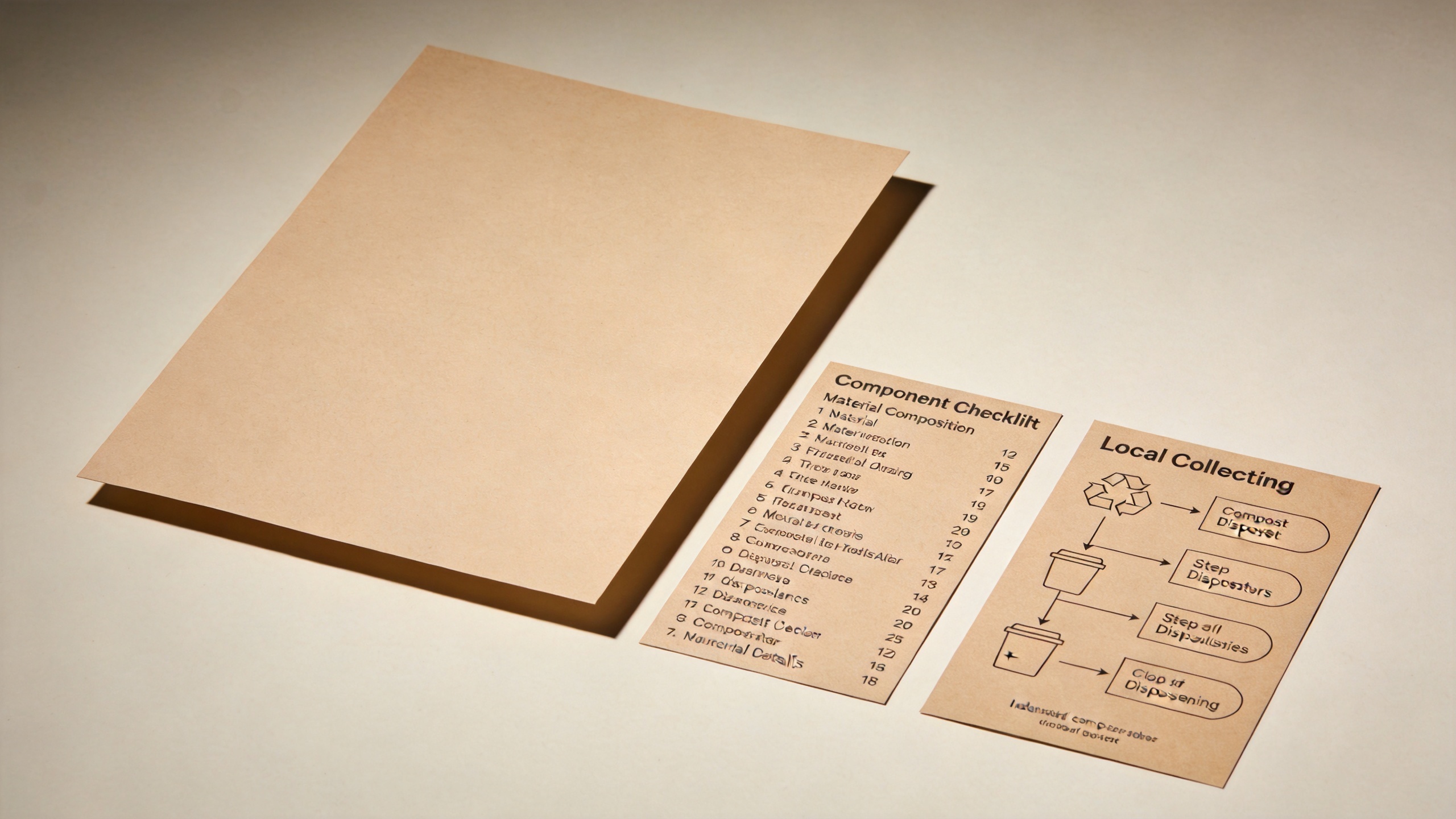
A four-part review before approving a claim
- Define the use case. Is the paper used as wrapping, an insert, void fill, a food-contact layer, or an outer pack? The use affects exposure to moisture, contamination, and added materials.
- Map the finished bill of materials. Include paper, print, coating, adhesive, labels, and any attached accessories. Do not evaluate the sheet in isolation.
- Match evidence to the claim. Ask what test method, certificate, or technical record supports the exact wording. Confirm the documentation applies to the finished item and intended market.
- Write disposal instructions with conditions. State the route only when it is documented and locally meaningful. If local acceptance is uncertain, tell users to check their local program.
This checklist makes biodegradable packaging paper easier to specify responsibly. It also reduces costly rework when a marketing team, procurement team, and converter are using different definitions of “eco-friendly.”
Common mistakes that weaken disposal compliance
Assuming paper automatically means compostable
Paper can be an important component of a lower-impact design, but paper alone does not settle the question. A treated surface or attached component can change the disposal result. The better practice is to evaluate biodegradable packaging paper as a finished package component.
Using a certification name without matching the scope
A standard or certificate may apply to a material, a component, or a defined product construction. Before using it in sales copy, compare the certificate scope with the actual grammage, printing, coating, and accessories. This may feel cautious, although it protects both the claim and the buyer.
Giving a disposal instruction without local context
Even well-documented biodegradable packaging paper cannot override local collection rules. A concise qualifier such as “check local acceptance” is often more useful than a universal disposal statement.
How packaging teams can make a defensible decision
Start by treating sustainability as a decision set, not a single adjective. The initial question may be, “Is this biodegradable?” More accurately, it is, “What is this exact packaging construction designed to do after use, and what evidence supports that outcome?” That shift helps teams choose biodegradable packaging paper with a clearer brief.
For sample approval, inspect the material in the same form customers will receive. Test the print, adhesive, label, and packing routine together. Then review the proposed claim against the available records. If the intended route is composting, confirm that the wording reflects the appropriate facility and conditions. If the route is recycling, check local guidance and make sure any barrier treatment has been considered.
A supplier discussion can be equally practical. Ask for the material specification, component list, relevant test or certificate scope, and recommended claim language. The goal is not to force a label onto every paper format. It is to choose biodegradable packaging paper only when the evidence, construction, and disposal guidance align.
Final takeaway
Biodegradable packaging paper can meet strict disposal expectations when the assessment goes beyond the base sheet. The final construction must be documented, the relevant standard or test scope must fit the intended claim, and disposal guidance must respect real local systems. In short: confirm the use case, review every component, match claims to evidence, and give customers disposal instructions they can act on.
That approach gives brands a stronger basis for selecting packaging paper, communicating environmental information responsibly, and avoiding a claim that is broader than the supporting evidence.